Thursday, March 19, 2009

Kristoffer Ragnstam's "Wrong Side of the Room"

Lots of reviews for Swedish song-writer Kristoffer Ragnstam seem to feel he can be compared to Beck. It’s true that he seems to have some of the eclectic tastes which has made Beck such a staple on the American music scene, but perhaps it’s unfair to look so far afield for influences.


There have been other important bands which suggest Sweden has a thriving music scene on its own terms. The Wannadies, for one, had some great (though more angry) guitar-pop in the 90s which Ragnstam at times seems to echo. Then there was American’s brief affair with The Hives. Though past their best now, they have done some great punk-pop music over the years. The question is then, will Kristoffer Ragnstam take up the mantel for the Swedish music scene?

It certainly looks like it. Ragnstam’s latest record, “Wrong Side of the Room,” is catchy and energizing in turns. Mixed by renowned Blur, Radiohead and Supergrass engineer, Chris Brown, it manages to be both polished and edgy.


His lyrics fit this model too. The song “2008,” for example, is a great mix of the humorous and poignant. The track begins with the lines “Nothing bores me more than an overrated poet/ with an acoustic guitar, and way too much to say.” As you begin to smile, he turns to sing “Nothing makes me feel more lonely/ than when I’m all alone, with you honey,” and you are suddenly in a quite different place.

Ragnstam has already had some success, touring in support of Debby Harry in 2007. With this new record, it looks like that was just the beginning, and Ragnstam will now make another assault on American shores, we hope even bigger, and more sustained, than his predecessors.

Tuesday, March 10, 2009

REVIEW: Ghost of the Russian Empire's "The Mammoth"

No-one ever said I was timely in my reviews. Austin Texas’s Ghost of the Russian Empire released their “The Mammoth” album last year, and it fell through the cracks for me. So this review is an apology, to Ghost, for my (quite literal) ignorance.

“The Mammoth” is an album shrouded in mystery. Ghost use so much reverb on most of their tracks that everything has a cloudy, lost feel to it. Vocals, in particular, drift past you incomprehensibly, swathed in ringing echoes of themselves. This is compounded with the dearth of information on the band (their ‘website’ is just a picture of the album cover – a cleverly engineered mystique?), and you start to wonder if Ghost are obscure, or obscured.


My comments may make it sound like “The Mammoth” is one big studio mishap, but here I feel sure Ghost are entirely in control of their direction. They claim a deep affiliation with Radiohead, but I don’t see it. Nonetheless, their album has some of the deep warmth of BRMC’s “Take them on, On Your Own,” some of the swagger, in songs like the excellent “Bleeding Machines,” of Kasabian’s eponymous first album (particularly tracks like “Reason is Treason”) – rolling bass is the only element you can hang onto while the song wheels around you.


So I highly recommend Ghost of the Russian Empire. They play dark music you can sink into, and sink your teeth into.

Tuesday, March 3, 2009

The Duke Spirit live at FELT

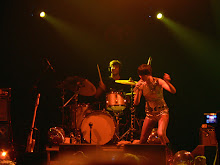
Tonight I pull myself away from a whirling first few days with my newborn child, and go into Boston to see the excellent Duke spirit. We fight our way to FELT through the blustery rain, and weave through unmarked doors and up dark stairwells to find the small room in which they will play. This maze like course makes the whole event feel like admission to something cosseted and secretive.


(The Duke Spirit at another (bigger) venue)

The set up is so small that after a few minutes shaking the rain off our coats and getting drinks, the band simply walk up right past us, from the back of the room, and pick up their instruments. This is a very cool band with an image to uphold, and tonight we get to feel, in this cloistered space, like we’re really part of their scene. Singer Liela Moss tells us that her dad used to live in Boston, presumably in the hopes that this will make the band seem more at home here. She need not worry, though nothing about the Duke Spirit seems to fit Boston, or even America (at one point she says, with some embarrassment, “Oh, I sounded a bit American then, didn’t I”). Instead, the crowd comes to the band – we are transported to some pub in Camden, North London, to hear the energy of the Duke Spirit playing on their home ground. It’s a rare chance to let a band show us where they are really coming from.


(Moss gives it her all, on their last tour)

Moss seems to exude so much calm confidence, and her voice, which sounds like it might break at any moment (but never does), is compelling. The rest of the band are no less able to project their control over the room, as they lead us through lots of tracks from last years “Neptune,” some B-Sides, and a couple of new tracks. I’ve missed the chance to see the band in the past, but after tonight I’m glad I got the chance to see them first in such an intimate setting, before their future success means they will play more distant shows.

Check out “Neptune” and feel the Duke Spirit’s great soul-pop music, so you’re ready for the next time they grace us with their presence.

Monday, February 16, 2009

Interview: Bell X1

Since their last full album, Flock, came out back in 2005 in their home of Ireland, Bell X1 have been through a blur of touring, line-up changes, big performances on shows like Letterman, the occasional tour-bus fire shenanigans, and – happily for the rest of us – some new recording.


The result of all this is “Blue Lights on the Runway,” an album which, when I caught Bell X1 singer Paul Noonan while in LA recently, I discovered is born of draughty old Irish castles and Eastern European getaways. It is an album that should justifiably draw Bell X1 a whole new audience of devotees. Tracks like “The Great Defector” are fun and approachable, and others, like closing song “The Curtains are Twitchin’” show Bell X1 are worthy competitors to (though also comrades of) bands like The Frames.

I began my interview with a question for the engineer in me…

Nick: I wanted to start by asking about recording the new album, [“Blue lights on the runway.”]. How much involvement do you have in the recording process? Are you really hands on with that stuff?

PAUL: I think we’d be pretty hands on at this stage. This is the first album that is ‘our record’ – we fully own it – and we’ve got lots of studio gear that we’ve amassed over the years, and we tend to just find a nice space to put it up in. We’ve done the last two records that way.

Nick: So effectively you’ve produced the album yourself?

PAUL: Yes, well our good friend Bill Hayes has been involved in the last two records. I wouldn’t be too au fait with the technical aspects, but Dave [Geraghty] is good at that.

Nick: You recorded in Dublin, yes?

PAUL: Well, we found a castle in the middle of Ireland. It had these great big drafty rooms with high ceilings – really for lords and ladies. There’s all this really characterful old stately homes that are very cold, but have great acoustics.

Nick: Was this album recorded all in one place?

PAUL: Yes. We try to keep going until we have to stop, so we did maybe a month of recording in the house and then, between all the bouts of touring we did last year, we’d take some time and maybe use people’s houses to finish things up.

Nick: It seems like it’s becoming more and more rare these days to record everything in one place.

PAUL: That seems to be the way things are going as the recording process has evolved.

Nick: Do you think it affects the project a lot, whether you record in one place or many?

PAUL: Yes, I think often you can overwork things as a result of meddling, as opposed to the recording needing that work. We did a session the other day with Steve Lilywhite in New York, and he was very much of the opinion that you should come into a proper studio, having rehearsed a shit-load, and having a pretty good idea of where you’re going. He put forward the somewhat controversial hypothesis that Sergeant Pepper… being the first high profile band who really didn’t know what they were going to do until they got in the studio, and then they used the studio as an instrument… that Sergeant Pepper killed music, which I think is being willfully controversial…

Nick: That is a pretty extreme perspective!

PAUL: Yeah, you can be wonderfully creative by looking at it that way too.

Nick: One track I really liked was “The Great defector” - it seems to me to have a lot of Talking Heads in it? Are they a big influence of yours?

PAUL: Yes, they would be. We may have gone a bit far with that one! But yes, when I first saw the video to Road to Nowhere, as a young kid, the physical comedy, as well as the visual aspect, appeals to people of a really young age. I suppose only in the last few years have I gone back and listened to their earlier records and loved them.

Nick: So you’d say they were a major influence then?

PAUL: They have been. I remember when we were making our second record [Music in Mouth] in 2002 in Chiswick, London, and we’d go back from the studio to our flat each night and one of the guys would put on their album “Fear of Music,” which I had never heard, and was a really joyous thing to hear when you’re in the throws of a creative process. It was a real inspiration.

Nick: Yes, there’s that great track – if I recall correctly – “American Guitars” or “Electric Guitars”…

PAUL: Yes, “Electric Guitars” is a great one.

Nick: So, given this big influence from an American Band, would you say you would have more roots in Irish or American music?

PAUL: Well, I don’t really think of us as an Irish band, whatever that means…

Nick: I mean, is there a big difference between music from the two places still, do you think?

PAUL: Yeah, Ireland has a bunch of very strong singer-songwriters, because the oral tradition in Ireland gives it that strength. You grow up [in Ireland] in a culture of storytelling, and playfulness with language, and I think that makes a big difference to the music scene. But I don’t think of us as particularly from that world, although being Irish does have a big influence on my writing.

Nick: The drums parts and synths in songs like “How your heart is wired” have some 80s overtones.

PAUL: We’re not exactly re-inventing the wheel with that, but we did have a lot of fun playing with synths and drum loops. I suppose I wanted to take tracks that we would have written in a more tradition way – on acoustic guitar or on piano – say Dave and I, at each other’s houses, and then take those songs and dress them in beats, etc. so they’d sound a little more fresh, but not change the backbone of the song.

Nick: So do you think that’s coming out of some older musical interests, or is it resurgent right now in general?

PAUL: I think it comes out of an appreciation for older bands. We are big fans of Depeche Mode, and we learnt a couple of their songs to play acoustically, and we discovered that their was great writing there – songs that would stand up with a single voice and acoustic guitar. We really like New Order as well, on the strength of their songs.


Nick: Could you talk a little bit about your creative process, since you seem to have so many roles in the band! How do things usually get started?

PAUL: There’s no real formula for it. In the past when we’ve landed on something that works and then tried it again, it doesn’t, which I suppose is one of the beauties of music. This time around I spent some time alone in Eastern Europe writing, and learning the more computer based ways of producing songs, so a lot of the initial writing was done like that. With the last record we were in a position to start songs with the four us [together], from scratch, but this time the songs were pretty well formed before we all got together.

Nick: So the Eastern European trip you did, was that specifically to write, or were you there for other reasons?

PAUL: It was just to get and away and write. In Dublin there are too many distractions!

Nick: I understand you still do the drumming when you’re in the studio – is that right?

PAUL: This is actually the first one I haven’t done. Tim O’Donovan, who’s been playing with us live for year did them this time.

Nick: So does that imply your moving to ‘fronting’ the band more? How does it feel when you go back to that instrument [the drums]?

PAUL: I really enjoy it. I miss it when I don’t do it. I try to get out once or twice a year and tour as a drummer with other bands. But we don’t really have that sharply defined roles within Bell X1 – we move from instrument to instrument. I enjoy not playing drums while recording all the time. I enjoy the freedom of being able to sing properly. I don’t see that as a new role for me really. Bringing Tim in to play drums gave us an injection of his energy and his feel for things. It’s quite a rhythmically driven record and we talked a lot about that, and he [Tim] has his own style which was a great thing to capture.

Nick: You’ve toured with The Frames in the past. I wondered what your thoughts were about the effect of the popularity of The Swell Season, and the film Once, on the Irish music scene? Is the scene really thriving right now?

PAUL: I don’t really know. I think for a long time the term Dublin band was a derogatory one, associated with a sort of blusterous pub-rock. I don’t think that’s any longer the case – that stereotype doesn’t ring true. I mean, there’s great electronic music in Dublin, there’s good, straight ahead three piece rock bands, there’s even some good hip-hop. It is pretty diverse. The singer-songwriter scene is still very strong, and some of that is the result of once. Glen [Hansard] is such an established singer-songwriter, and he’s connected to so many different eras of the singer-songwriter. That fact that he’s achieved this recognition, it pulls everybody up. It re-enforces the idea of quality song-writing from Ireland.

Nick: Thanks for you time, and good luck with the tour. I’m hoping to be at the Boston show myself.

PAUL: I’m sure it will be a messy affair, but we’ll try to keep order!

Saturday, January 24, 2009

Raveonettes and Nickel Eye at Paradise.

Just before this gig started, I passed distinctively chiseled Strokes’ bass player, and front man of Nickel Eye, Nikolai Fraiture, coming out of the bathroom at the Paradise. Just a little star-struck, I mumbled “have a good show” to him, and he thanked me casually, before disappearing backstage.


I really meant it too. But just a few minutes later, as Nickel Eye ran through some of the songs they have been playing around the country from their upcoming first album, “The Time of the Assassins,” I had changed my tune completely. By that point I had stood listening to them wander through track after track, looking, frankly, like they might fall asleep on stage. This is not a criticism of their music particularly (although I wasn’t taken with it – it was weak and generally lacking in drive), but of their incredible complacency. I have rarely seen a band apparently less interested in an audience’s opinion of them. I suppose that’s what they call ‘cool’ in musical circles. Nikolai sang “Don’t let them get you down,” and I suppose I am now the object of his statement. So be it – the band can’t be given a free pass to ‘phone it in,’ on the basis of the momentum they have gathered from Nikolai‘s past life.


The Raveonettes, who followed them, are cool in quite different terms. Their style, melding 50s harmonies and guitar drenched in spring reverb with massive bass and screaming noise-core distortion is still fresh and engaging, even after several years at what many critics label the cutting-edge. A friend who came to the show with me argued afterwards that they are not so new as they might want us to believe – that bands like Suicide have been over this ground before.


Perhaps he’s right. Perhaps this incarnation of ‘cool’ has overcome my judgment. I could tell they wanted to keep up appearances for the crowd when singer Sharin Foo broke at our applause, from her sultry passivity, into a smile. She looked like she had given something away – a secret that, perhaps she feared would damage their dark image. A secret that they really do care what we think, and that they need us.

How ‘uncool,’ and how endearing.

Ghosty's "Answers"


Kansas’s Ghosty are an easy band to write about, because they have roots in so many different, great bands of the last 15 years. They are like a super-group founded by members from four or five seminal indie acts. There is some Elliot Smith in the vocals, some early Black Crowes in the guitar, some Pavement (circa “Wowee Zowee”) in the bass, some National in the drums and keys. What brings these bands together is the mellow drift of their melodies, and the soft warmth of their tone. Ghosty uses this combination of elements to write calming songs that run over you like water.

“Answers” is undoubtedly a very successful album because their quiet confidence shows they achieved exactly what they intended to with this production. Is there a down side? Only that soft waves of sound can lull you into a state where the more complex lyrical or even melodic moves, which the album sometimes makes, are lost as you slip into lethargy.


What you loose from this kind of problem is not something you will notice though. To drift your way though beautiful music, sometimes unconscious of its depth, is only really a loss to the band. “Answers” is like the flowers that seduced the Lotus Eaters – a sweet album from which it is hard to pull yourself away.

Thursday, January 15, 2009

Tonight! Raveonettes at Paradise.

Tonight I'd like to recommend that you take a deep breath and step into the deep-freeze that our town has become, to go and see The Raveonettes, supported by Nickel Eye, at the Paradise. If anything could generate heat, it's Sune Rose Wagner's noise-core grind over Sharin Foo's soft, low vocals.


Nickel Eye, which is the band name used by Strokes bass player Nikolai Fraiture, are also generating a good deal of talk on the East-Coast scene. Amazingly, it looks right now like the gig is still not sold out. You should take this as a sign that you are being called to the venue, and join me down there.

A review to follow...

Saturday, January 10, 2009

REVIEW: TV on the Radio's "Dear Science"

A few years ago I saw TV on the Radio supporting Yeah Yeah Yeahs, and I really didn’t get it. Nothing seemed to gel for the band that day. All the strands that I can hear in their latest album, “Dear Science,” were there, but they remained disparate and seemed to struggle against one another. For one thing, they were playing support to a band I felt were the epitome of experimental, but controlled, guitar music, and somehow TV on the Radio were working against that control.


I suppose what I wanted out of the band was pop music (in its broadest sense) – that is, I wanted to hear hooks and melodies I could follow and reproduce in my mind. But, at least when I approached the band for the first time in a live setting, they just didn’t seem to cohere in that way. With “Dear Science,” that has all changed.

I don’t mean to suggest that I want straightforward music that is easy to digest, and I’m certainly not saying “Dear Science” is a ‘simple’ pop album. What it is, though, is an album which speaks to me (and hopefully to others) in a subtle but lucid language which can lead us carefully through intricacies with the band, rather than having us scratching our heads ‘on the outside’ of the album.


I have recently entered the fray regarding the Fleet Foxes, another band who have collected more accolades for their latest album than I have pipe dreams of super-stardom. Rolling Stone, Pitchfork, NME, The Guardian etc. etc. have all leaped to TV on the Radio’s cause. This degree of hysteria makes me nervous, and inherently resistant.

Unlike in the case of the Foxes though, I really think there is some justice in a system that gives institutions like NME such sway over all our opinions in this case. They are absolutely on the money when Louis Pattison says the album is one of the best of the last year. “Dear Science” is packed with beautiful moments, elegant harmonies over heavy synths, driving rhythms moving around jazz brass sections – the list goes on. From playing a cacophonous gig in Boston city center that I quickly dismissed, TV on the Radio now have my absolute attention.

Tuesday, December 30, 2008

REVIEW: Bug Lung Baby’s Trilobite Trash EP AVAILABLE FREE


When you’re out, and you meet a band member for the first time, there is a painfully irresistible urge to ask them “what do you sound like?” It’s a tiresome question that most of the musicians I have met detest being asked. After all, they dream, how can all the time – all the teary heartache – I’ve put into this sound be quantified? How dare this person ask?!

So the conversation turns to the musician’s elliptical attempts to say that their sound is unique, that from one moment to the next it is entirely unpredictable, that it breaks new ground. Now a cringe-worthy question has led to a cringe-worthy answer, because, in the end, how many bands do you ever heard who aren’t more or less conventional? Not necessarily bad, but predictable.

It comes as a great surprise then, when you steel yourself for another typical musical experience, and something really fresh comes along. This FREE EP from Bug Lung Baby is just such an interesting, twisting and turning project. It leads you through elements of lot of different genre, and bends them to its will.

Trying to drive it back to something a little more interpretable, it’s closest to being called “laptop music,” but it’s better than most. Laptop music is generally muddy and garbled, as the musician constructs confused anti-musical ramblings, while Trilobite Trash retains an addictive quality that means it’s still as simply enjoyable as something which is a lot less original.

There are musical precursors of sorts, like very early (i.e. good) Beck, or Ian Brown, but I think it’s fair to give Bug Lung Baby his due, and say that he’s writing something worthy of praise, simply because this EP is something which we haven’t really heard before. Go and pick up this FREE music and enjoy a genuinely strange musical journey.

Friday, December 19, 2008

Super Furry Animal's Classic, Mwng.

[...in conjunction with the record breakers section of Ryan's Smashing Life]

Ryan recently asked me to write about a past album that was under-appreciated. The list is long, and SFA's 2000 'folk' album Mwng is right at the top.


I heard a story that when the Super Furry Animals came out with “Guerilla” in 1999, they were so annoyed that their label didn’t push it enough to rocket them to superstardom that they became cynical about the music business in its entirety, and decided to record their next release (and first free of their contract with Creation), “Mwng,” entirely in hardly radio-friendly Welsh.

I have no idea if this is true or not, of course. But if the label were guilty of failing to promote the absolutely stunning electronic majesty of “Guerilla,” and that did prompt this album, then I offer them my first born in thanks (just give me a couple of months to get one). “Mwng” is quite simply one of the most exquisitely beautiful folk-pop albums I have ever heard.

After the traditional (for this band) out of place opening blast which leaves you completely unprepared what will happen next, SFA make the pace softer and softer, until they reach the nadir of “Nythod Cacwn,” half way through the album. [Singer Gruff Rhys played the drums on this track himself – you can tell, and yet it is completely in keeping with the track’s incredibly fragility]. Then the album begins to ramp up again, until it hits tracks like "Ysbeidiau Heulog", which are carried by guitarist Bunf’s super heavy overdrive, mixed very low in the background, so they sound like both sick and gorgeous at one and the same time.

The real wonder of this album is perhaps attested by the fact that I have always felt that lyrics are the single most difficult thing to really get right in any musical project, although they are often the last to be considered. But this album shows me that I’m dead wrong. I have absolutely no idea that Gruff is talking about in this album. I’ve actually got the point where I’ve avoided researching this, because I really don’t want to be troubled with any actual meaning. Instead, I want tracks like "Gwreiddiau Dwfn" / "Mawrth Oer Ar y Blaned Neifion" to carry me off into the kind of mixed-up, dizzying, sweetly dark world that only SFA can deliver (and trust me, they leave the best for last). Consider this a call to arms – find this album at all costs and make the effort to work your way through it with the care it deserves. It. Will. Pay. You. Back.